Importers
There are a number of import formats in myStage. For each file see the details below.
Running an import
Import files can be CSV files or Excel files (.xlsx or .xls). For Excel files, the first sheet is imported, and the first row must contain the column headings.
- In Administration, click Import.
- Choose the File Type (the import format, listed below).
- Choose the Event to import into.
- Choose the File to import, and click Submit.
You will see Import started. and a progress bar while the file is imported. When it finishes you will see Done! with the number of records imported, and a link to Import another file.
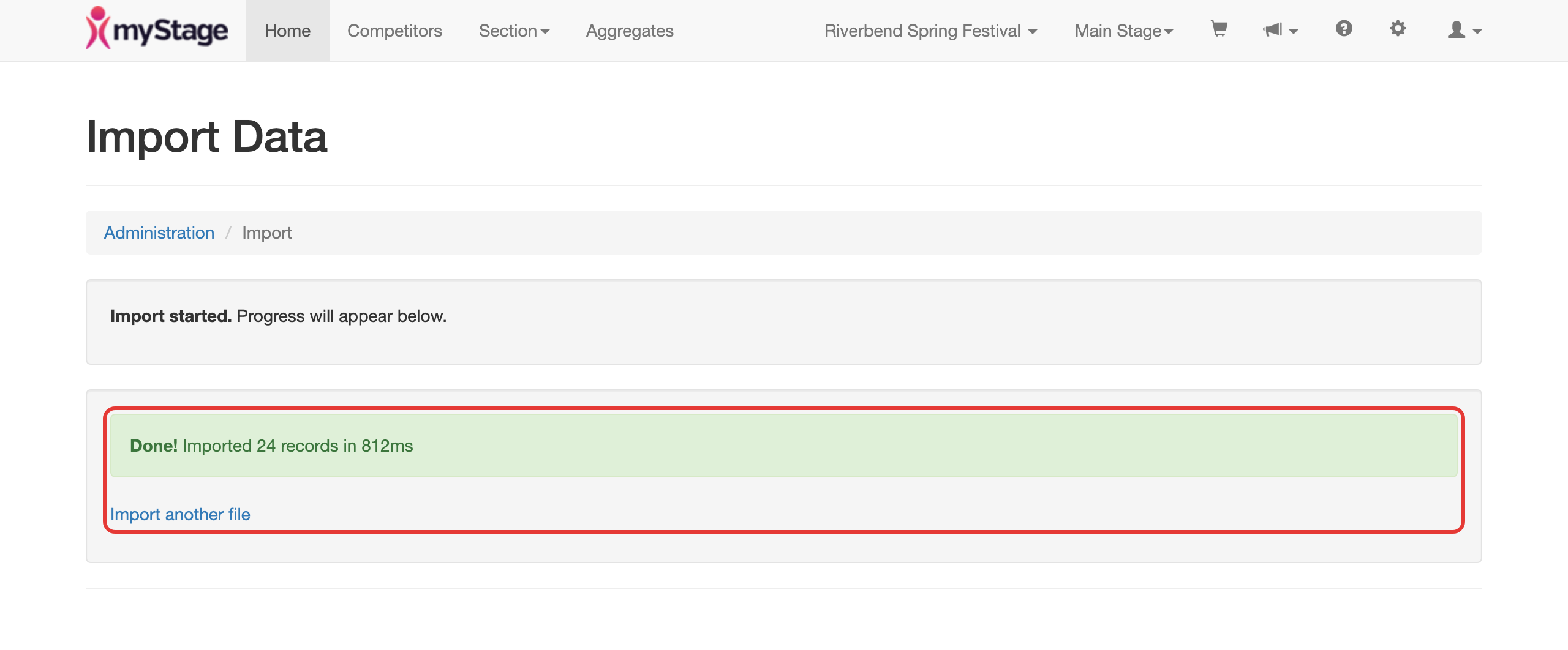
If the import can't be completed, you will see Import failed. with the reason, for example "There are columns missing from the import file: Discipline,Age". Fix the file and click Try again.
Important
Importing can take a while, depending on the size of the file. Only one import can run at a time. If another import is running you will see "An import is already in progress. Please wait for it to complete." If an import fails and you can't work out why, contact support.
Excel dates and times
Excel files are read as the values are displayed in each cell. Make sure date and time columns are displayed in the format shown for each column below (e.g. dd/mm/yyyy), or format them as text.
Column headings must match the names below. Required columns are checked before the import starts.
Stardom
Stardom has a file export that gives the following columns. Details on each column and how they are used is below.
Example File
| Column | DataType | Required | Notes |
|---|---|---|---|
| Program | Text | No | Not used |
| Discipline | Text | Yes | |
| Session Date | Date | Yes | dd/mm/yyyy |
| Session Start Time | Time | Yes | hh:mm AM/PM |
| Session Description | Text | No | Not used |
| Section Order | Number | No | Not used |
| Section | Number | Yes | |
| Section Description | Text | Yes | Name of the section |
| Competitororder | Number | Yes | Performance Order |
| Official Entry Name | Text | Yes | Name on the entry |
| Individual Competitor Names | Text | No | Used for duos etc |
| Date Of Birth | Text | Yes | dd/mm/yyyy hh:mm |
| School Name | Text | No | Imported as club |
| School Initials | Text | No | Not used |
| Teacher Name | Text | No | Not used |
| Registered First Name | Text | No | Registered user |
| Registered Surname | Text | No | Registered user |
| User Type | Text | No | If not competitor, a related user is created |
| address1 | Text | Yes | User address line 1 |
| address2 | Text | No | User address line 2 |
| City | Text | Yes | User city |
| Postcode | Text | Yes | User postcode |
| Text | Yes | User email | |
| phone1 | Text | No | User phone |
| phone2 | Text | No | Not used |
| Invoice Number | Number | No | Not used |
| Invoice Creation Date | Date | No | Not used |
| Entry Notes | Text | Yes | Column must be present, but it is not currently imported |
| Section Fee | Currency | No | Not used |
| Invoice Amount Paid By Stardom Credit Card | Currency | No | Not used |
| Invoice Total Amount | Currency | No | Not used |
| Invoice Total Unpaid | Currency | No | Not used |
| Adjudicator/s | Text | No | Optional column to record the adjudicator on the section |
| Writer/s | Text | No | Optional column to record the writer on the section |
| Coach Email | No | Creates or finds a coach user and links them to the competitor | |
| Coach Name | Text | No | Name of the coach, used with Coach Email |
| RD-name | Text | No | Registration data answers. Use RD- followed by the registration data Name, e.g. RD-Title |
Important
Anything section specific will only be read from the first entry that refers to that section. e.g. If the writer etc is different on subsequent entries it will be ignored.
TryBooking
The TryBooking importer may not match what you get out of TryBooking, depending on how you have setup your entries. However as long as you update the file format to match below it will import for you.
How competitors are matched
For each row, the importer looks for an existing competitor before creating a new one:
- If there is an Email, it looks for a user with that email. If the user's own competitor, or a competitor shared with them, has the same name as Competitor Name, that competitor is used.
- Otherwise it looks for a competitor with the same name and Age.
- If no competitor is found, a new competitor is created. If the email belongs to an existing user, the new competitor is linked to that user. If there is no user with that email, a user account is created for the email, linked to the competitor. The person can use the forgotten password option to log in and see their competitor.
Existing competitors that are found are linked to your organisation, and their address, date of birth and email are updated from the file. Second competitors on duo entries are also linked to your organisation.
Example File
| Column | DataType | Required | Notes |
|---|---|---|---|
| Section Name | Text | No | Not used |
| Division | Number | No | |
| Location Code | Text | Yes | Code that matches locations in codesets |
| Discipline | Text | Yes | |
| Section Description | Text | Yes | Full name of section |
| Session Date | Text | Yes | dd/mm/yyyy |
| Session Start Time | Text | Yes | hh:mm AM/PM |
| Location | Text | No | Not used |
| Competitor Number | Number | No | Performance order and competitor number |
| No | User email, used to match or create the user | ||
| Entry Type | Text | No | Not used |
| Competitor Name | Text | Yes | |
| Club/College | Text | Yes | |
| Coach | Text | No | |
| Age | Text | Yes | Recorded as text on competitor |
| Grade | Text | No | |
| Extra - DVD | Yes/Y/True/1 | No | See extras note below |
| Extra - Photos | Yes/Y/True/1 | No | See extras note below |
| Entry Notes | Text | No | Added as an internal entry note |
| Adjudicator | Text | No | Added to section |
| Writer | Text | No | Added to section |
| Sponsor | Text | No | Added to section |
| Date of Birth | Date | No | dd/mm/yyyy |
| address1 | Text | No | Competitor / User address |
| City | Text | No | |
| Postcode | Text | No | |
| State | Text | No | |
| 2nd Competitor Name | Text | No | Second competitor for duos |
| 2nd Competitor Date of Birth | Text | No | Second competitor for duos |
| 2nd Competitor Age | Text | No | Second competitor for duos |
| 2nd Competitor Email | No | Second competitor for duos | |
| Official Entry Name | Text | No | Team name |
Extras Import
The Extras - columns will import what comes after the - by matching to the codeset options for extras. e.g. DVD will add a DVD extra if it has a Yes, Y, True or 1 value.
Codeset
The Codeset importer lets you import a set of codeset values quickly. It will only import codes and values, you will need to edit other values from the Admin screen.
| Column | DataType | Required | Notes |
|---|---|---|---|
| Codeset | Text | Yes | The name of the codeset to import |
| Code | Text | No | Unique code for the codeset value |
| Value | Text | Yes | The value to add for the codeset |
| Discipline | Text | No | For the Item codeset, the discipline the item belongs to |
Teams - Variable Items
The teams variable items importer imports a team schedule quickly, when you don't have all the competitor information.
Example File
| Column | DataType | Required | Notes |
|---|---|---|---|
| Discipline | Text | Yes | Matches Code then Value |
| Date | Text | Yes | dd/mm/yyyy |
| Division | Text | Yes | Matches Code then Value |
| Age Group | Text | Yes | Matches Code then Value |
| Start Time | Text | Yes | hh:mm (24 hour time) |
| Location | Text | Yes | Matches Code then Value |
| Adjudicators | Text | Yes | |
| Writers | Text | No | |
| Item | Text | Yes | Name of the item |
| Time Limit | Text | No | Matches code in the time limit codeset |
| Performance Type | Text | No | Matches code in the performance type codeset |
| Split | Text | No | Matches Code then Value |
| C1 | Text | Yes | Team name See competitor columns, below |
| C1-# | Number | No | Performance order for the team See competitor columns, below |
| C1-#E | Number | No | Number of competitors in team See competitor columns, below |
| C1-EX-DVD | Text | No | Yes/Y/1 |
When importing with this file, any blank cells in columns before the competitor details (Cn) columns will use the value from the cell above that has a value. For example, you can put the date in the first row, and leave subsequent rows blank until the date changes.
Competitor columns
The competitor columns are listed in performance order, so that a program schedule can be imported. These work by looking for columns of Cn, where n is the competitor number. IE C1 might be Ballarat, C2 Geelong etc. The importer will stop once it can no longer find a Cn column in number order, i.e. 1-7 are there, but no 8.
Cn-# is the performance order for that team. If it's blank, the team is added to the end of the section. Cn-#E is the number of competitors in the team. For the example above you would need C1-# to C7-# (and C1-#E to C7-#E if you are recording team sizes).
Cn-EX-xxx is for importing extras. As above, Cn would be the number. -EX- says we are looking for an extra, and xxx is the code e.g. DVD.
Multiple teams for the same club
When a club has two teams performing in the same age group / division they need to be imported as the same competitor for aggregate calculations.
To do this, in the Cn column you need the team name, with the number in brackets after. ie. Ballarat for team 1, and Ballarat (2) for the second team.
Warning
If you don't put the team number in brackets (1) they will import as two competitors, showing up separately in the aggregate.
Codeset Matching
When importing and matching codesets, the Teams - Variable Items importer will check for a matching code first. If it doesn't find a match, it will then check for a value. If neither are found a new codeset value will be created to match.
Users
The user import lets you import public users to allow them to manage competitor profiles.
| Column | DataType | Required | Notes |
|---|---|---|---|
| Club | Text | Yes | |
| First name | Text | Yes | |
| Last name | Text | Yes | |
| Text | Yes | ||
| Link | Boolean | No | true to find any competitors with this name as a coach, and link them. |
| User Type | Text | No | Recorded as the relationship when competitors are linked |
User - Invite
Choose Users - Invite as the file type. The same as the user import above, but it will invite the users with an email.
Coaches
Import a list of coach names. Used when you want to restrict entries to competitors that have an approved coach.
| Column | DataType | Required | Notes |
|---|---|---|---|
| First Name | Text | Yes | |
| Last Name | Text | Yes |
Clubs
Choose Clubs (and Classes) as the file type. The club import is used like the coach import, when you want to have the competitor enter only if they are from an approved club/school. You can also upload the class times if they have to choose that during their entry process.
| Column | DataType | Required | Notes |
|---|---|---|---|
| Name | Text | Yes | |
| ClassName | Text | No | |
| Day | Text | No | |
| Time | Text | No |